Prepare safely
Survey land, test soil and water, review pond and overflow design, confirm stocking advice, secure boundaries and establish a local operator and backup.
Before stockingFounder-led pilot concept · Darbhanga, Bihar
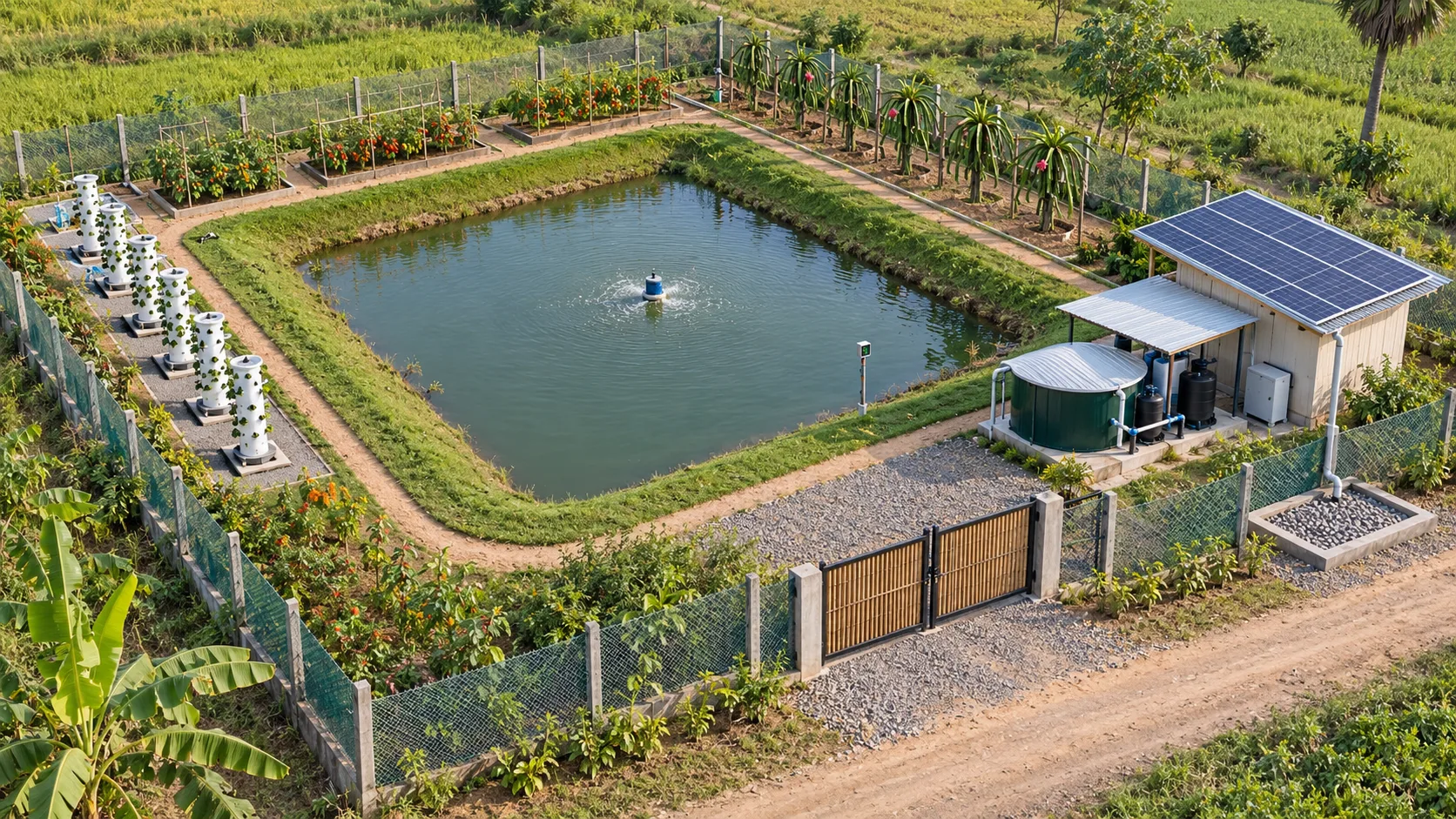
Aquahub imagines a quarter-acre farm where freshwater fish, carefully chosen crops, water systems and useful technology work together. The first goal is simple: build one real hub, measure what happens, and learn whether it can serve small farmers.
Current stage: working plan and design concept. The site, economics and technical details still need local validation.
For many small farmers, a pond, a crop area and a power supply are separate decisions. Aquahub asks whether they can be designed as one manageable system: food for the household, products to sell, a place to work and rest, and records good enough to learn from.
It starts with freshwater carp. Premium greens and vegetables are trials, chosen only after local agronomy and buyer checks. Freshwater scampi and wider rollout come later, if the pilot earns them.
Explore the system 02 / 04
Choose a part of the concept to see how it fits. The arrangement and dimensions are illustrative until the land is surveyed and the pond is designed locally.
The proposed module
A starting space budget allocates roughly half the quarter acre to the pond, three tenths to dry crop and tower strips, and the rest to access and utilities. A survey, bank design and operating routes will reshape these proportions.
Proposal only · final layout depends on surveyed land, soil, water and local expert review.
The four images were developed for the founder’s working vision. They show a possible mature arrangement, not existing infrastructure, verified yields or an approved engineering drawing.
A design boundary
Pond-derived water can be trialled in a separate plant circuit, while clean rainwater and pond overflow each have their own assessed route. The system should make water use measurable, not merely claim savings.
Screened withdrawal, filtration and a covered reservoir feed a small tower trial. Tower drainage returns to that plant reservoir, not to the fish pond.
Roof and panel runoff may be harvested or directed to a separately assessed clean-water recharge route.
Overflow needs a safe, locally agreed route. Crop-circuit drainage must not enter the recharge pit.
A useful first device 03 / 04
The technology is a prototype, not an operating control system. Select a scenario to see the intended behavior; this interface displays no live farm data.
The proposed unit records dissolved oxygen, temperature and pH with timestamps and quality flags. Readings are stored locally, then uploaded when a connection is available.
Illustrative product behavior · no measured values or live connection.
Every five minutes, the proposed unit would log locally. An operator would add test results and daily farm events. Initial alerts focus on whether the monitoring system itself is healthy; water-quality thresholds come only after reference testing and local operating procedures.
No automated aerator or pump control. No prediction or digital twin is claimed at this stage.
The proof path 04 / 04
The first Aquahub is a learning site. Its purpose is to replace assumptions with observed operating, crop and financial records.
Survey land, test soil and water, review pond and overflow design, confirm stocking advice, secure boundaries and establish a local operator and backup.
Before stockingStart with carp and basic monitoring. Trial a small number of crops and selected-edge towers only after water chemistry, access, climate and buyers are checked.
Pilot operationComplete a fish cycle and seasonal crop trials. Compare outcomes, operating effort, water flows and actual net results before considering another farm.
Expansion gateThese are questions for the pilot, not promised outcomes.
A meaningful first discussion is about validating site feasibility, building one safe pilot and funding the measurement needed to judge affordability for small farmers. A priced funding ask, return forecast and commercial rollout plan will follow real design and operating data; they are not asserted here.
The path beyond one plot
The hub must prove value after feed, labour, electricity, maintenance and crop losses. The monitoring service also needs a form small farmers can actually access.
Build the evidence together
I’m looking to speak with people who can help stress-test the pilot: aquaculture and horticulture specialists, field operators, buyer partners and patient early supporters.